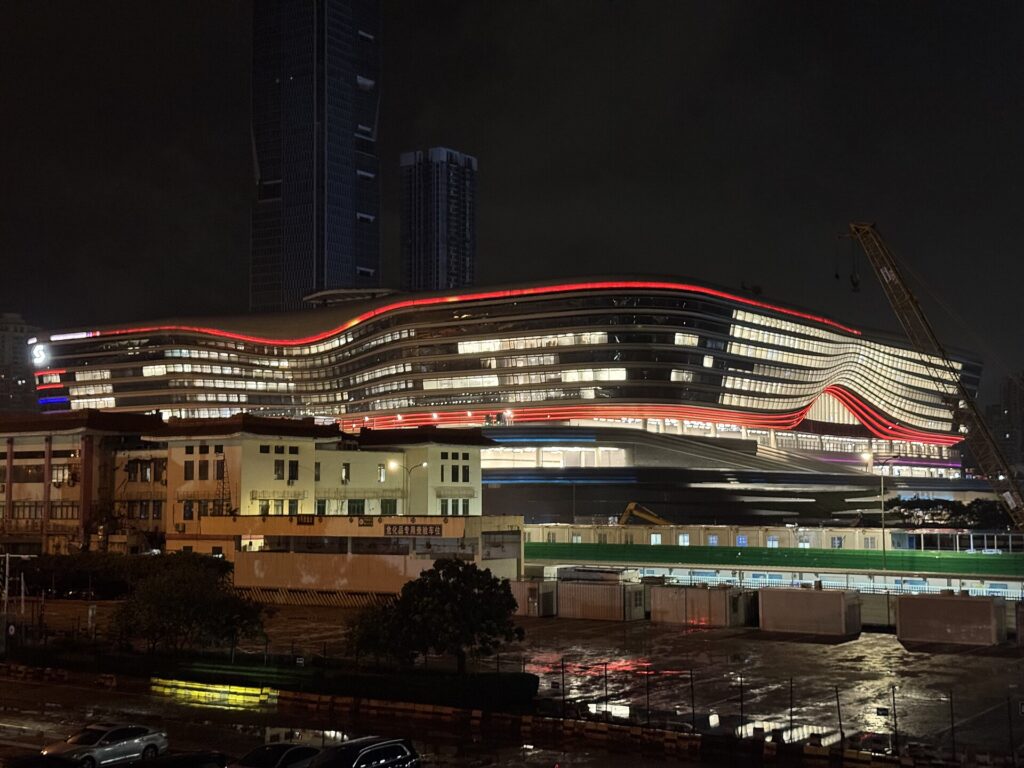
The rebuilt Huanggang Port drew nearly twice the old crossing’s traffic on its first day, though officials had told travelers not to rush. The Lok Ma Chau Spur Line was quieter, and queue data are still missing.
The rebuilt Huanggang Port handled 71,638 passenger trips on its opening day, Monday, October 12, according to Immigration Department data, about 1.8 times the traffic at the old Lok Ma Chau Control Point on an ordinary Monday in late September. Officials had asked people not to rush.
That is one day of figures, and the main caveat sits next door. The Lok Ma Chau Spur Line rail crossing handled 12,500 to 15,600 fewer trips than on the two late-September Mondays, September 21 and 28, which suggests some of Huanggang’s crowd moved over from other crossings rather than appearing from nowhere. Lo Wu handled 7,300 to 8,400 fewer, but its total was within 1.5% of September 7 and 14, so its dip is the weaker signal. The department publishes totals by control point, not where travelers would otherwise have gone, so that reading is an inference.
What the first-day figures show
The port opened at 6:30 a.m. under a joint notice issued October 9 by the Security Bureau and Shenzhen’s port office, with 24-hour clearance for passengers and passenger vehicles, while passenger clearance between Lok Ma Chau Control Point and Shenzhen’s temporary Huanggang building was suspended. By 5 p.m., Security Bureau figures reported by HK01 put the count at 42,212 passenger trips, 20,201 in and 22,011 out, plus 5,708 vehicle trips, and The Standard gave matching rounded totals. The Standard called the passenger figure nearly triple the usual for the same period and the vehicle figure about 12% above usual, without stating the baseline.
The Immigration Department’s daily statistics allow a cleaner comparison. Huanggang recorded 34,516 arrivals and 37,122 departures, and Lok Ma Chau Control Point a further 10,201 trips, which the daily series does not split by hour. On September 21 and 28, both Mondays, Lok Ma Chau handled 39,477 and 39,587. The opening-day total is above the 65,000 that RTHK reported on October 9 as the current maximum daily capacity, and about 36% of the new port’s 200,000 daily capacity. Shenzhen border inspectors counted 52,200 trips by 6 p.m., Guangming Online reported, a separate count with a different cutoff.
What changed for travelers
The procedure changed as much as the building. Under the “collaborative inspection, joint clearance” model, enrolled travelers queue and present their identity documents once to clear both Hong Kong and Shenzhen, using 134 automated channels alongside 68 manual counters, the Immigration Department said in an October 6 release. Drivers in “joint one-stop” lanes give temperature, travel document, face and fingerprints once at an integrated device, according to an October 10 government release. Passengers in cross-boundary private cars must now get out at a drop-off area and carry their luggage through the passenger hall. The Yellow Bus shuttle across the river was scheduled to make its last runs that morning, and franchised bus, minibus and coach routes now run straight to the port.
Secretary for Security Chris Tang said on opening morning that waits in the joint vehicle lanes were under five minutes, HK01 reported, and DotDotNews reported him putting vehicle clearance time at about two minutes, down from about 10. Reporters’ own timings that day were mixed. HK01’s reporter waited about 20 minutes in the buffer area before reaching the lanes and saw some lane queues of 20 to 30 minutes, while a Ta Kung Pao reporter also waited about 20 minutes in the buffer area, and the driver cleared the lane in about a minute and a half on the return trip.
Analysis: the advice versus the turnout
The Transport Department’s October 7 plan, covered by TockHK on October 9, asked the public to use other crossings at first, and the October 10 release said people “do not need to rush to use the new Huanggang Port.” Many did anyway. Across Lo Wu, the Spur Line, Shenzhen Bay, Heung Yuen Wai and Lok Ma Chau with Huanggang, combined traffic on October 12 was 638,387 trips, 2% to 4% above the two late-September Mondays. On that basis the day looks more like a reshuffle toward Huanggang than a jump in total crossings, which is what matters for bus, minibus and coach operators: crossing traffic at the new port rose sharply while the rail crossings saw slightly less.
What the government has not published is the part travelers feel. There are no official taxi queue times, no bus loadings or frequencies for the new routes, and the department’s daily series covers passengers, not vehicles. Secretary for Transport and Logistics Mable Chan said at an October 12 media session that public transport had been “smooth and efficient,” that a buffer area near the port “can accommodate around 200 vehicles,” and that the government would “not underestimate the challenges to be brought about in the coming long weekend.” The 200-vehicle figure fills one gap in the October 7 plan. How fast that buffer empties under holiday load is still unknown.
The first Monday went smoothly by the government’s account, though Huanggang drew a far bigger crowd than the old crossing despite the advice not to rush. The long weekend, with tour coaches and day-trippers, is the test the figures have not yet covered.