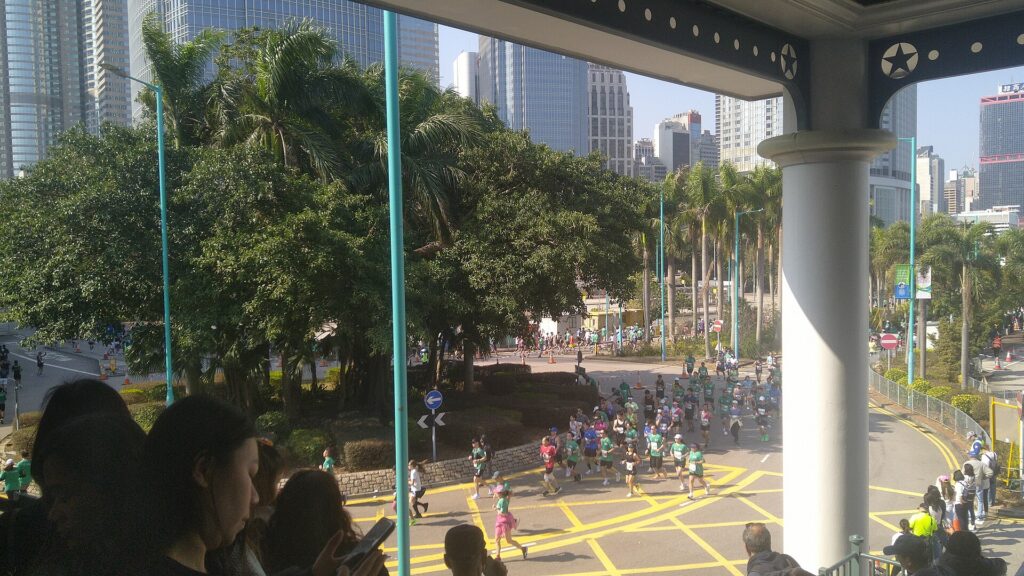
Receipts attached 3 sources
Sources
-
Other source
First Northern Metropolis Marathon held
Reports route, turnout and runner feedback.
-
Other source
First Northern Metropolis Marathon Held
Independent newsroom reporting on the event and runner feedback.
-
Other source
Northern Metropolis Marathon event details
Logistics and 42.195 km listing.
Limits
The full-marathon distance is listed as 42.1 km by RTHK and 42.195 km by the organizer. Start-point descriptions differ between RTHK and TVB and are attributed to each outlet. The claim that this was the first marathon on the Fanling Bypass since it opened rests on TVB alone. The hero is an illustrative image of a separate January 2026 race.
Corrections
No correction notes have been added for this article.
About 15,000 people took part in Hong Kong’s inaugural Northern Metropolis Marathon on November 1, running a new northern course that broadcasters said ran mostly smoothly but included traffic-light crossings and a stretch shared with cyclists, according to RTHK and TVB News. RTHK quoted Heung Yee Kuk chairman Kenneth Lau as saying he was surprised by the turnout.
The event was staged by the Heung Yee Kuk as part of its 100th anniversary and offered full marathon, half marathon and 10km races alongside shorter individual and family runs and a carnival, the organizer’s event details page shows. RTHK said runners began setting off in Shek Mun from about 6:30am, and the organizer page lists an overall event window of 6am to 1pm.
What the first course covered
RTHK reported that full marathon runners started at 6:30am in Shek Mun, where the Heung Yee Kuk is headquartered, then headed north via the Hong Kong Science Park, Tolo Highway and the Lam Tsuen River in Tai Po, passing through the Lung Shan Tunnel before finishing at the recently commissioned Fanling Bypass. It said half-marathon runners followed a similar path, starting at the Science Park and also finishing in Fanling.
TVB News gave a closely matching account, reporting that the full marathon started at 6:30am at the Heung Yee Kuk building in Sha Tin, with runners passing the Science Park promenade, turning onto Tolo Highway, heading north along the Lam Tsuen River and running through the Lung Shan Tunnel to finish at the bypass. TVB said it was the first time the Fanling Bypass had served as a marathon route since it opened in May.
The exact full-marathon distance is reported inconsistently. RTHK described a 42.1km race, while the organizer’s event page lists the marathon as 42.195km, the standard marathon distance; neither source explains the gap, so the precise figure should be read with that caveat.
Runner feedback on heat and crossings
RTHK said most participants described the arrangements as smooth, but reported that some runners, depending on timing, had to briefly stop at traffic lights at a crossing to let cars pass, and that one section of the route saw runners sharing a bike path with cyclists. A finisher identified by the surname Lai told RTHK that running in about 28 degrees Celsius was tough and that there was a lack of water stations, saying there should be one every 2.5 kilometers rather than every three to four.
TVB reported similar mixed impressions of the course itself. It said one runner found the route challenging because of elevation changes but called the Northern Metropolis scenery refreshing, while another cited winding streets in Fanling and a headwind on the bypass as making the race difficult. Both outlets framed these as runner impressions of a first-year course rather than evidence of any wider problem.
The organizer’s chairman, Kenneth Lau, acknowledged to RTHK that the day’s temperature of around 25 degrees Celsius was not ideal for running, and said he hoped future races could be held in December if possible. No changes for future editions were announced in the reports.
Where the organizer hopes the route can go
Lau told RTHK that many people had asked whether runners could eventually go all the way to Shenzhen, and said he believed a future route could extend to San Tin, the Lok Ma Chau Loop, or even into the Shenzhen area as infrastructure work in Yuen Long and the broader Northern Metropolis continued. TVB reported the same aspiration, noting Lau’s explanation that current construction in Yuen Long limited this year’s path.
Those remarks describe hopes for how later editions might connect to more of the developing area, not an approved or scheduled cross-border course. Nothing in the broadcasters’ reports or the organizer’s page indicated that any such extension has been granted or planned.
RTHK quoted former SAR representative Chan Ka-ho, who finished fourth overall in the men’s marathon, as saying Hong Kong has only three or four full marathon courses and that the new route offered a fresh experience; he added that while it was not a fast course, it could appeal to recreational runners drawn to the Fanling Bypass and the Lung Shan Tunnel.
For a first edition, the race delivered both a sizeable field and an early list of things to refine, from water stations to the timing of the next run. Whether the course one day reaches toward the boundary, as its organizer imagines, will depend on roads that are still being built.