Receipts attached 5 sources
Sources
-
Other source
Pair rescued after working platform plunge
Incident, rescue sequence, hand injury.
-
Other source
Two workers dangle after Jardine House gondola fault
Separate account of location, approximate report time and height; page access is limited.
-
Other source
Jardine House suspended-platform incident and lifelines
Separate rescue account and reported lifeline use.
-
Other source
Two workers rescued after gondola fault at Jardine House
Separate account of safety lines, round windows and workers' positions.
-
Other source
Code of Practice for Safe Use and Operation of Suspended Working Platforms
Sections 6.3.1 to 6.3.5 on harnesses, anchors and independent lifelines.
Limits
The cause of the platform's drop and the precise equipment configuration have not been established by a published technical finding. News accounts differ in detail; timings and height are attributed to the outlet reporting them. The Labour Department code describes general requirements, not a finding of breach in this incident.
Corrections
No correction notes have been added for this article.
The Jardine House rescue on October 26 ended with two workers brought safely off the outside of the Central tower after their suspended working platform dropped, according to RTHK’s account of the emergency response. Both were wearing safety harnesses. The cause of the platform’s movement has not been publicly established in the accounts reviewed for this article.
Police received a report shortly after 6 p.m. that the platform had stopped operating, leaving the workers stranded against the building, RTHK reported. Firefighters abseiled to bring one worker to the ground at about 7:40 p.m. and pulled the other to the roof shortly afterward. One worker was taken to Queen Mary Hospital with a hand injury.
What the Jardine House rescue established
The workers were left outside one of Central’s most recognizable office buildings for roughly two hours. South China Morning Post’s separate report placed the incident at about 6:16 p.m. on Connaught Road Central while the pair were carrying out external maintenance. The report described them as more than 30 stories above ground. Those details come from the paper’s reporting; they are not a finding about why the platform fell.
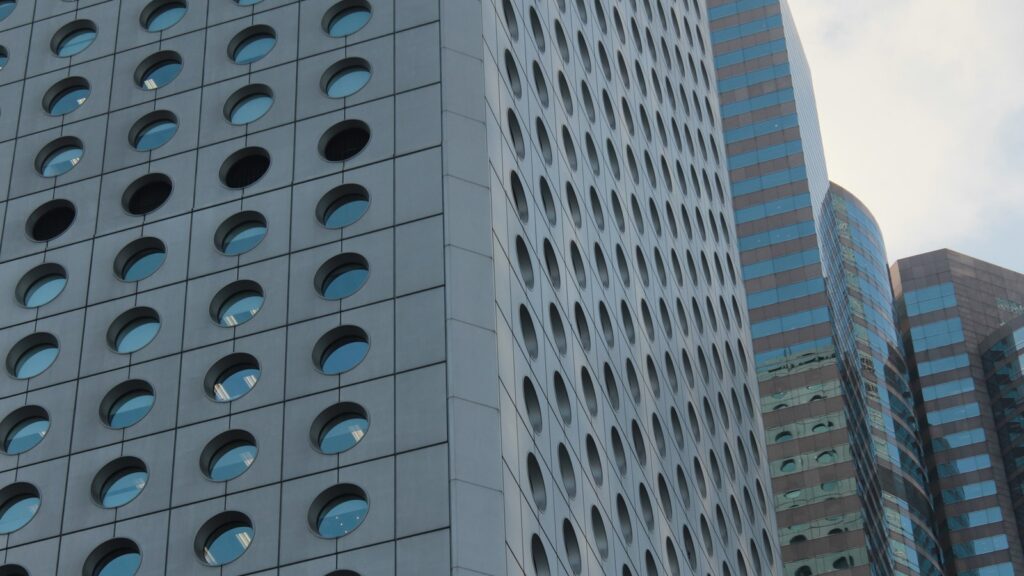
Sing Tao reported that the two workers’ harnesses were attached to independent lifelines and that they waited by the building’s round windows before firefighters reached them. A separate account from Dim Sum Daily described the pair as secured by safety lines and waiting outside the tower’s circular windows, positioned roughly eight floors apart, as emergency crews responded. These accounts describe what was visible during the rescue, not a technical inspection of the platform or its anchors.
It matters whether the suspension equipment, the platform controls or another component failed, but no public engineering finding has answered that question. The workers’ use of harnesses cannot establish that every safeguard was in place, either. The immediate confirmed outcome is narrower: both were brought to safety, and one was taken to hospital with a hand injury.
Why the lifeline is separate
Hong Kong’s Labour Department publishes a Code of Practice for Safe Use and Operation of Suspended Working Platforms. Its section on safety belts and lifelines calls for a suitable harness and an independent lifeline or appropriate anchorage for each person. The code specifies a full body harness meeting a recognized national standard rather than a general-purpose safety belt, and says no more than one lanyard should be anchored to each independent lifeline. For temporary suspended platforms, it says the harness lanyard should be secured to an independent lifeline anchored separately from the suspension system, and that the lifeline should not be secured to the roof rig, outriggers, parapet clamps or counterweights.
The rule is not an absolute requirement for an independent lifeline in every configuration. The code allows an exception for a permanent suspended platform suspended by two ropes at each end, where the lanyard may instead be hooked to a manufacturer-designed eye bolt on a structural member of the platform. Where a permanent platform uses safety ropes and automatic safety devices, the lanyard should be anchored to an independent lifeline. The code also requires notices in English and Chinese on the platform reminding every rider to wear a safety belt attached to an independent lifeline or a suitable anchorage. Which configuration applied at Jardine House is not established by the published accounts.
That design separates a worker’s fall protection from the machinery carrying the work platform. If the platform moves unexpectedly, a properly attached independent line can provide a separate means of support. This is the purpose of the rule, not a conclusion about the exact configuration or performance of equipment at Jardine House. Those details require an inspection that the published news accounts do not supply.
The code also addresses training, examination, maintenance and operation of suspended platforms. None of those requirements should be converted into an allegation of a breach on the basis of a rescue video or a brief incident report. Whether the equipment was defective, and whether any duty was breached, remain separate questions.
The two workers’ rescue is the news. The larger question is what caused a platform being used on a high-rise facade to drop. Until an authority or the operator publishes a finding, the event should be described as a platform incident, not a proven mechanical failure or a proven safety violation.