Receipts attached 4 sources
Sources
-
Other source
EPD air-quality advisory, 13 October 2026
-
Other source
2018 Pearl River Delta PM2.5 research
-
Other source
EPD live AQHI
-
Other source
Hero image
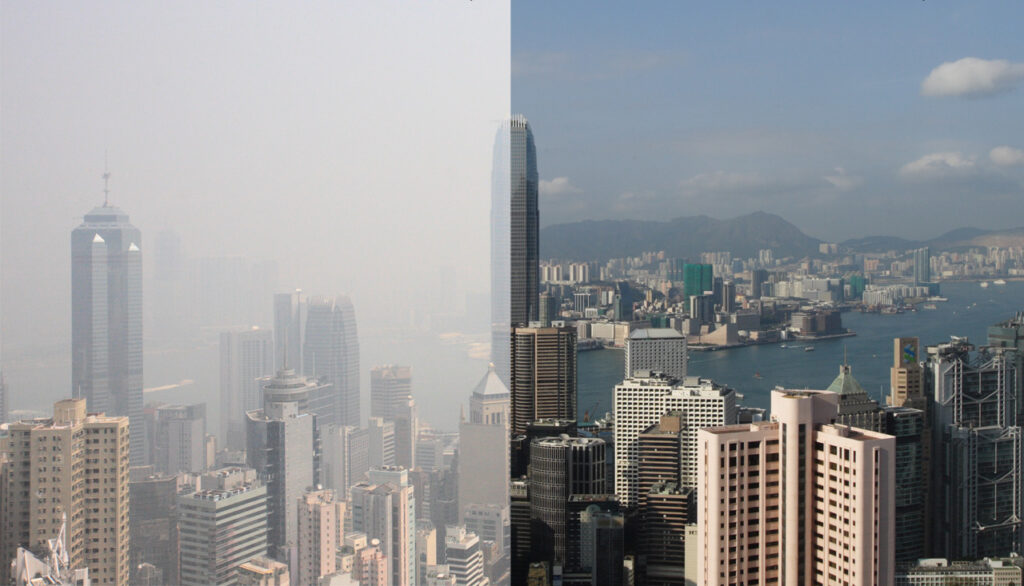
Archival or illustrative image; see credited media caption.

Limits
The 13 October event attribution is the EPD’s official explanation, not independent causal proof. The 2018 regional study is background; no event-specific fire, dust or back-trajectory dataset was obtained.
Corrections
No correction notes have been added for this article.
A serious air-quality episode this month shows why bad air cannot be reduced to a single source or a passing weather front.
When Hong Kong’s air turns hazy, the wind direction can seem to offer an easy explanation. But a northerly wind does not, by itself, show what pollutants are in the air, where they were emitted or how they formed. The Environmental Protection Department’s account of a serious air-quality episode on 13 October points to a more complicated mix of weather and chemistry.
What happened on 13 October
The EPD said pollution rose above normal levels that afternoon and the Air Quality Health Index (AQHI) reached the “Serious” health-risk category at some monitoring stations. Weak winds hindered dispersion. Intense sunshine, the department said, accelerated photochemical smog activity and the formation of ozone and fine particles across the Pearl River Delta; high ozone also promoted the formation of nitrogen dioxide.
That was the department’s explanation for the episode. Its advisory did not attribute the pollution to wildfire smoke or dust. The absence of those words is not proof that neither contributed; it means the advisory does not establish either as the cause.
What “from outside” can mean
Regional transport does matter. A peer-reviewed study published in Atmospheric Chemistry and Physics in 2018 examined sources of fine particles across the Pearl River Delta. Under polluted northerly airflow in winter, the researchers estimated that transport from outside the delta accounted for more than half of the measured PM2.5. Secondary sulfate was the most abundant component of that transported portion. They estimated that emissions in the central delta supplied about 45 per cent, with secondary nitrate and biomass burning among the most abundant source categories there.
Those are estimates for the conditions and sites the researchers studied, not measurements of Hong Kong’s air on 13 October. They show why “transported pollution” is not a synonym for smoke from fires. Fine particles may include substances formed through atmospheric reactions, as well as material emitted directly.
Nor does the EPD’s description mean every future autumn episode will have the same cause. Wind, sunlight, emissions and atmospheric chemistry change from day to day. A claim that smoke or dust drove a particular event would need evidence tied to that event, not merely an upwind location or a hazy skyline.
Which number should readers use?
For health decisions in Hong Kong, use the EPD’s current AQHI readings and advice. The AQHI is a local health-risk index; it is not interchangeable with the US-style air-quality index shown by some third-party maps. In its 13 October advisory, the EPD advised children, older people and people with existing heart or respiratory conditions to minimise or avoid physical exertion and outdoor activities when the risk category is “Very High” or above. At “Serious”, it asked employers of all outdoor workers to assess the risk and take protective measures.
The defensible conclusion from this episode is limited but useful: the EPD identified weak winds and regional photochemical smog as drivers on 13 October. Research shows that pollution can also travel into the delta and take several chemical forms. Neither fact alone establishes a smoke plume over Hong Kong.