Receipts attached 13 sources
Sources
-
Other source
Sunday Huanggang passenger update
19,000 two-hour departures; 9,728 peak hour; wait times; crowd control
-
Other source
RTHK Sunday report
Confirms weekend crowd and government response
-
Other source
New port opening notice
October 12 06:30 opening; 24-hour passenger clearance
-
Other source
Collaborative inspection channel enrolment
Eligibility and one-queue, one-document automated joint clearance
-
Other source
New port transition arrangements
Old Huanggang/Lok Ma Chau passenger closure and new port transition
-
Other source
Huanggang transport arrangements
Seven buses, six minibuses, five coaches, taxis and buffer area
-
Other source
General holidays for 2026
Monday October 19 substitute Chung Yeung holiday
-
Other source
Freight closure at Huanggang
December 21 freight closure
-
Other source
Fresh-food route at Man Kam To
Fresh-food vehicle exception
-
Other source
Huanggang port photo
4080x3060 CC0; pixels inspected; predates rush
-
Other source
Manpower shortage at Huanggang Port
Staff letter, missed breaks, e-channel issues, department response
-
Other source
Huanggang staffing report
Reported collective message, Chan Cho-kwong account and department response
-
Other source
Huanggang port handles increase in passengers
Monday inbound count and official assessment

Limits
Staffing allegations are attributed to TVB, The Standard and a lawmaker. The complete staff message and shift rosters were not published in those accounts. The Immigration Department reports added staff and redeployment but gives no shift headcount. Monday inbound and Sunday outbound counts cover different periods.
Corrections
No correction notes have been added for this article.
Updated October 20: Frontline staff have raised concerns about staffing and breaks at the 24-hour port. The Immigration Department says it hired additional staff before opening and will adjust deployment as needed.
The rebuilt Huanggang Port had been open for six days when its first holiday rush exposed the limit of a faster immigration hall. On Sunday, October 18, roughly 19,000 people headed from Hong Kong to the mainland through the port between noon and 2 p.m., according to the Security Bureau. At the busiest hour, it counted 9,728 outbound trips.
The bureau said people entering the building during the peak waited about 30 to 45 minutes at crowd-control arrangements on Level 2, then up to 30 minutes in the departure hall on Level 5. It opened every clearance channel and diverted the crowd with police assistance. The surge eased after 2 p.m. These are official wait-time estimates, not a count of every traveler’s entire journey.
Freight left before passengers arrived
Huanggang stopped clearing cross-boundary goods vehicles in December 2025. The wider “East in East out, West in West out” policy directs freight toward Heung Yuen Wai/Liantang and Shenzhen Bay, while Man Kam To remains a route for fresh-food vehicles requiring inspection. That shift made room to recast Huanggang as a passenger crossing.
The new port opened at 6:30 a.m. on October 12. Passenger clearance at the temporary Huanggang facilities and the Lok Ma Chau Control Point ended at the switchover, consolidating their traffic in the new building. The redeveloped port operates 24 hours a day for passengers and passenger vehicles.
Its “collaborative inspection and joint clearance” arrangement lets eligible travelers complete Hong Kong and mainland checks through a single automated channel. The promise is fewer repeated stops inside the building. Sunday showed that a quicker channel does not eliminate a queue when departures arrive in a concentrated wave.
The first real surge
The Security Bureau said the noon-to-2 p.m. outbound flow was more than eight times the comparable period at the old Huanggang/Lok Ma Chau crossing. The comparison reflects an exceptional holiday peak against an older baseline, not a normal daily growth rate. The Immigration Department urged travelers to consider other crossings during the rush.
Sunday was Chung Yeung Festival. Because it fell on a Sunday this year, Hong Kong’s substitute general holiday is Monday, October 19. The weekend was the new building’s first major travel test, but a complete holiday-period accounting was not yet available when this article was prepared.
Staffing becomes the next test
After the first holiday surge, reports of a message from frontline immigration staff have raised a different question: whether Huanggang has enough people to keep its clearance channels supervised through a full shift. TVB reported that a person claiming to be an immigration officer wrote to management about short staffing and a lack of meal or rest time. It also reported concerns about e-channel jams. The identity of the writer and the staffing claims have not been independently established.
The Standard reported that a collective staff message described empty supervisor rooms and unanswered emergency calls. Lawmaker Chan Cho-kwong told a radio programme on Tuesday that the messages came from an employee WhatsApp group intended to alert management. He said all clearance channels were open during the holiday rush, but staffing affected shift rotations and field command. The reports do not include the complete message or shift rosters.
The Immigration Department said it had looked into the circulating messages, had recruited additional staff before the port opened, and would continue to monitor operations with mainland authorities and redeploy personnel as needed. Its reported response did not give a shift-by-shift headcount or establish whether each complaint was accurate.
On Monday, the Security Bureau counted about 9,400 arrivals from the mainland between 2 p.m. and 4 p.m., and officials described operations as generally smooth, RTHK reported. Those were inbound passengers on Monday; Sunday’s 19,000 trips were outbound during a different two-hour period. The two counts do not measure the same flow.
The port is open around the clock. Whether supervisors can be reached and staff can take breaks when a queue forms is now part of its operational test, alongside the speed of the automated channels.
The trip does not end at immigration
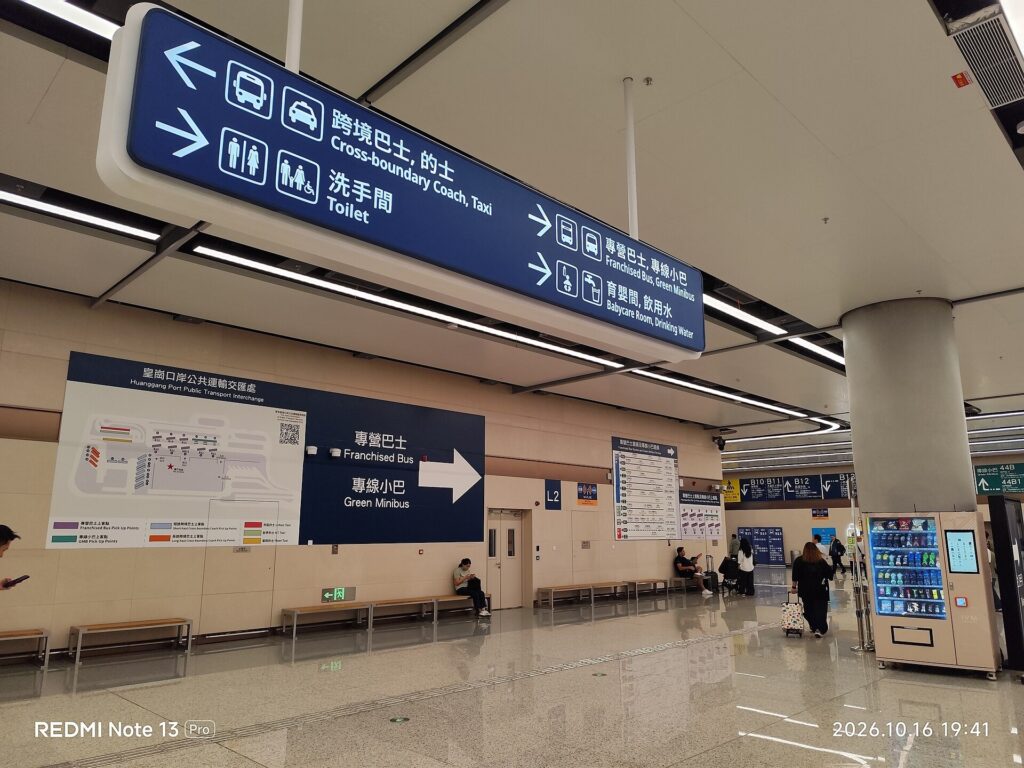
The Transport Department arranged seven franchised bus routes, six green-minibus routes and five round-the-clock short-haul cross-boundary coach routes for the port. It also set aside a nearby buffer area for backup public-transport vehicles that can be sent to pick up passengers when demand rises. Taxis have designated pick-up arrangements.
Those connections now matter as much as the clearance counters. The immediate bottleneck on Sunday was crowd control before and inside the outbound hall. The next question is whether buses, minibuses and taxis can carry away a similarly concentrated arrival flow without moving the line from one part of the journey to another.
The trucks are gone and the passengers have arrived. Huanggang’s first holiday surge did not stop the new crossing, but it did put a time on the queue.