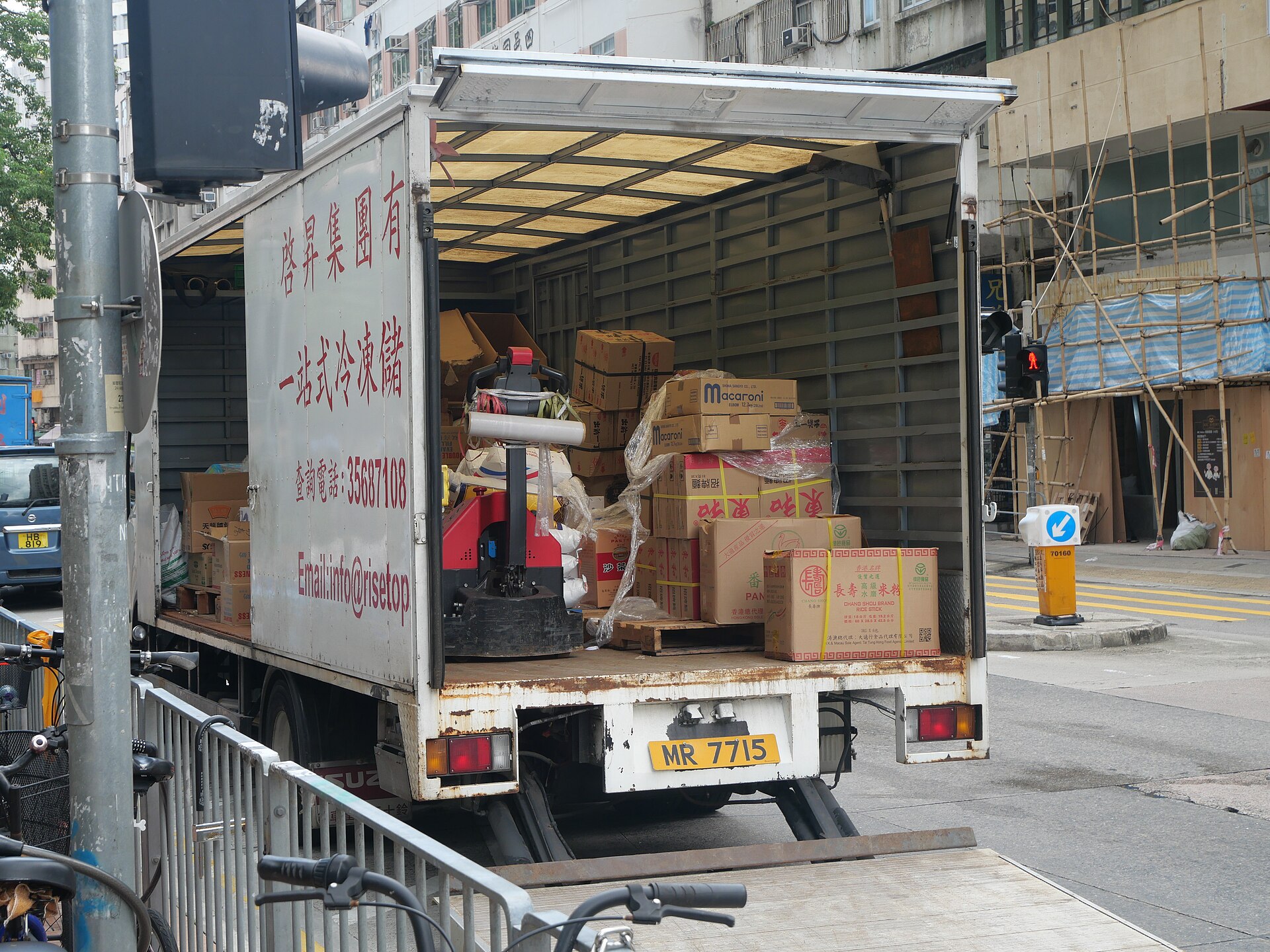
Hong Kong has 1,868 electric goods vehicles among 113,390 on its register. The government says heavy electric trucks are not ready, even as its Euro IV diesel phase-out enters its final stretch.
Only 1.6% of Hong Kong’s registered goods vehicles were electric at the end of August, according to a written reply to the Legislative Council from the Secretary for Environment and Ecology, Tse Chin-wan, on October 7. Private cars, by comparison, were at 27.5%.
The reply’s own table puts the gap in plain numbers: 1,868 electric goods vehicles out of 113,390, against 178,574 electric private cars out of 650,227 and 183,620 electric vehicles of all kinds out of 917,152, or 20.0% of the registered fleet. Goods vehicles make up about 12% of everything on the register and about 1% of its electric vehicles. One caveat matters before reading too much into the document. The question, from lawmaker Chan Han-pan, was about buses, taxis and older diesel vehicles, so road freight appears in one table row and one paragraph, and the reply sets no target or timetable for electric trucks.
Hong Kong electric goods vehicles: the government’s reasons
That paragraph is blunt. Electric commercial vehicles, “such as medium and heavy goods vehicles and non-franchised buses”, are “not yet ready for large scale application at this stage”, the reply says, citing purchase costs “significantly higher than those of diesel vehicles, limited driving range, lower load-carrying capacity, and longer charging time”. As analysis, for a trade that sells payload and hours on the road, two of those four limits go to the core of the business. The government says it has set up a working group that will “first explore the introduction of applicable models for public light buses”, not goods vehicles.
The reply places all of this inside the city’s goal of zero vehicular emissions before 2050 and refers to an updated electric vehicle roadmap announced in February. It does not say when, or on what evidence, heavy electric trucks might move from not ready to ready. Electric taxis, the scheme the question focused on, are the comparison the reply offers: first registrations rose from 17 in 2023 to 899 in 2025, and 634 more were added in the first eight months of 2026.
Euro IV diesel commercial vehicles: the deadlines stay
The other half of the reply concerns retirement, not replacement. The government launched an ex-gratia payment scheme in October 2020 to phase out about 40,000 Euro IV diesel commercial vehicles by the end of 2027, a group that, per the Environmental Protection Department’s scheme page, includes goods vehicles, light buses and non-franchised buses. More than 33,700 have been phased out, “nearly 85 per cent of the total”, the reply says, and the government has “no plan to extend the application deadlines for the remaining vehicles”, citing roadside air quality and a binding indicator in its First Five-Year Plan for 2026 to 2030 to bring average PM2.5 concentrations below 14 µg/m³ by 2030. The lawmaker’s question on this point asked about non-franchised buses and light buses, while the reply words its answer for “the remaining vehicles”.
That position follows a concession already made. On September 29, 2025, the department extended the payment application deadlines for Euro IV vehicles first registered in 2010 and 2011 by one year, to December 31, 2026 and December 31, 2027. Licenses for those groups still stop being renewed after December 31, 2025 and December 31, 2026 unless the owner obtains an exemption. The reply counts 310 Euro IV non-franchised buses and 82 light buses still on the road at the end of August. It gives no figure for goods vehicles. On the government’s rounded numbers, roughly 6,000 vehicles remain, and by elimination most of them would be goods vehicles, though the 40,000 was always an estimate.
The next truck replacement cycle
Here is what the logistics trade should take from the document, as analysis rather than anything the government has said. The scheme pays owners to scrap old trucks but, the reply notes, does not require them to buy a new vehicle at all, and the government’s own assessment says electric heavy trucks are not ready for large scale use. The likely replacement for a retiring Euro IV truck is therefore a newer Euro VI diesel one, which the reply credits with about 89% lower nitrogen oxides and 50% lower respirable suspended particulates than Euro IV for heavy vehicles. That is a real air quality gain. It is not a step toward zero emissions.
The clock on that diesel is already set. Under rules described on the department’s roadside air page, diesel commercial vehicles first registered on or after February 1, 2014 have a 15-year service life, so a truck registered this year must leave the road by 2041. That makes 2029, when the first trucks registered in February 2014 reach 15 years, the start of the next forced replacement wave, and trucks bought now will face their own deadline in the early 2040s. Operators already absorbing fuel cost uncertainty will want to know, well before then, whether heavy electric trucks, charging and payload rules will be ready for it. The October 7 reply does not say.
For now the city’s freight fleet is being cleaned up one diesel generation at a time. At 1.6%, the electric share of goods vehicles is a small slice with a large policy goal attached.